
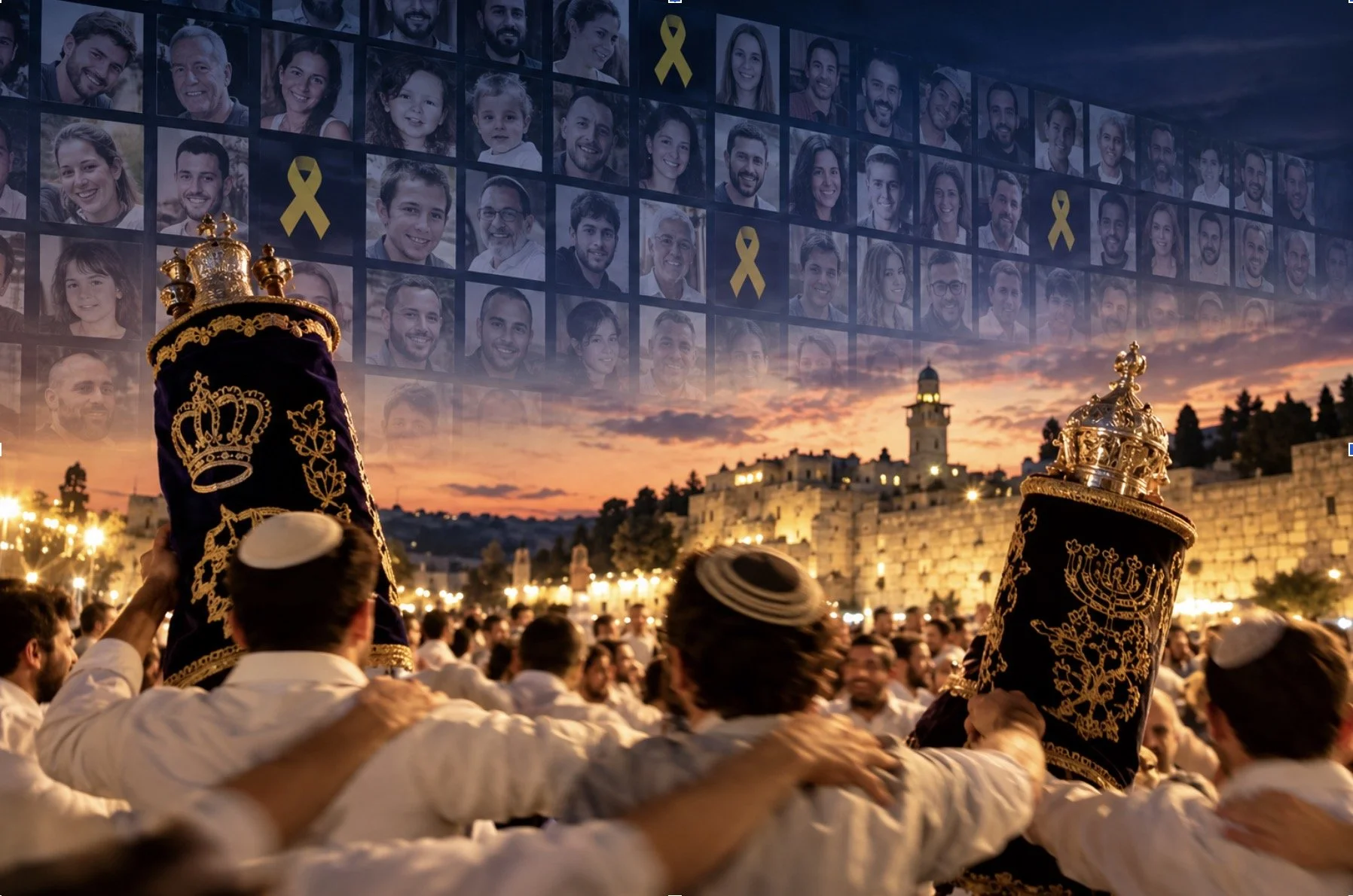
For the first Simchat Torah in three years, there are no Israeli hostages in Gaza.
Read that again.
None.
No living hostage waiting in a tunnel for someone to come. No murdered hostage still held by Hamas as a bargaining chip. No family waiting for a name on a list. No mother wondering whether her child is alive. No parents waiting for a body to bury.
They are home. All of them.
It is difficult to comprehend those words because, for three years, the hostages have been part of Jewish life.
The nightmare began as Israelis woke on a Jewish holiday to the worst massacre of Jews since the Holocaust. Families were murdered in their homes. Young people were hunted through the fields around the Nova festival. Children saw their parents killed. Parents saw their children killed.
And 251 people were taken into Gaza.
A baby. Children. Teenagers. Grandparents. Soldiers. Festival-goers. Foreign workers. Entire families.
Some came home in exchanges. Some were rescued. Some were recovered by Israeli soldiers. Some were murdered in captivity. And some remained.
For three years, those who remained became a kind of terrible clock.
Every release changed the number. Every rescue changed the number. Every recovery of a body changed the number.
Every announcement began with the same dreadful question: Alive or dead?
And all the while, something extraordinary happened outside Israel.
People became irritated by the hostages.
Their photographs were ripped from walls in London, New York, Sydney and elsewhere. Posters asking for kidnapped civilians to be returned were treated as political propaganda. Missing pets are given more dignity than Jewish victims of terror.
The words Bring Them Home somehow became controversial.
Think about that.
People had been dragged from their homes and from a music festival into Gaza, and asking for their release became a position requiring explanation.
Before Israel had even identified all its dead, people were celebrating the massacre.
Before the hostages had spent their first night in captivity, we were being lectured about “context”.
Then came the linguistic laundering.
Mass murder became “resistance”. Kidnappers became “militants”. October 7 became something that apparently required an asterisk.
And eventually, in much of the international conversation, the hostages simply faded away.
Gaza was discussed endlessly as though the war had materialised spontaneously. The photographs disappeared from news coverage. The yellow ribbons became background scenery. The people underground became inconvenient to a story in which there was room for only one set of victims.
But Jews did not forget them. We couldn't. There were empty chairs at Shabbat tables. Their photographs stood in synagogues. Their names were read at vigils. Yellow ribbons were worn on jackets and tied to fences.
At Jewish celebrations there was always something unresolved in the room.
Because somewhere in Gaza, one of ours was still there. That phrase — one of ours — will undoubtedly offend somebody. So be it. That is what peoplehood means.
You do not need to have met a hostage to understand that a Jewish child dragged into Gaza belongs to the Jewish family. You do not need to know the parents to understand their terror. You do not need to be Israeli to recognise the ancient horror of Jews being taken away while crowds celebrate.
For three years we carried their names.
Now there are no names left on the list.
The living are home. And the dead are home.
There is something especially cruel about describing the return of a body as a homecoming. But that is what these families were reduced to praying for.
Not resurrection. Not even rescue. Just: give us our child back so we can bury them.
That, too, was negotiable. That, too, became a bargaining chip.
And now it is over.
Not October 7. That will never be over.
The murdered remain murdered. Families remain shattered. Communities will carry what happened for generations. Soldiers died trying to bring people home. Survivors will live with things the rest of us cannot imagine. Some have already found that burden impossible to carry, taking their own lives after surviving the massacre itself.
October 7 did not end on October 7. For some, it never will.
There will be inquiries, recriminations and arguments. There should be.
But the hostage nightmare is over.
And look at the calendar. Simchat Torah. Of all days.
The festival on which Jews complete the Torah and immediately begin again.
The festival of hakafot, singing and dancing.
The festival Hamas turned into a day of slaughter.
For three years the Jewish calendar kept moving. Simchat Torah came and went. Jews danced because Jews have always danced, including when history has given them every reason not to.
But we danced knowing people were missing.
This year is different. This Simchat Torah, nobody is waiting in Gaza. Nobody.
There is something almost unbearably Jewish about that.
They tried to turn a festival of Jewish joy into an anniversary of Jewish slaughter. They failed.
The Torah will come out of the ark again. The circles will form again.
Children will sit on their fathers' shoulders. People will sing too loudly and dance badly.
And this year there will be no hostage count hanging over it.
So dance. Dance for those who walked back across the border. Dance for those who returned in coffins. Dance for the soldiers who went looking for people they had never met and never came home themselves. Dance for the families who spent three years refusing to let the world move on. Dance for every person who put a hostage poster back up after someone tore it down. Dance for the communities that kept saying their names when much of the world had stopped listening.
And while we dance, remember those who should have been dancing beside us.
Simchat Torah 2023 was the beginning of the nightmare.
This Simchat Torah, the last hostage has come home.
For the first time in three years, nobody is left behind.
We can finally dance again.
עם ישראל חי