
Why You Dislike Jews
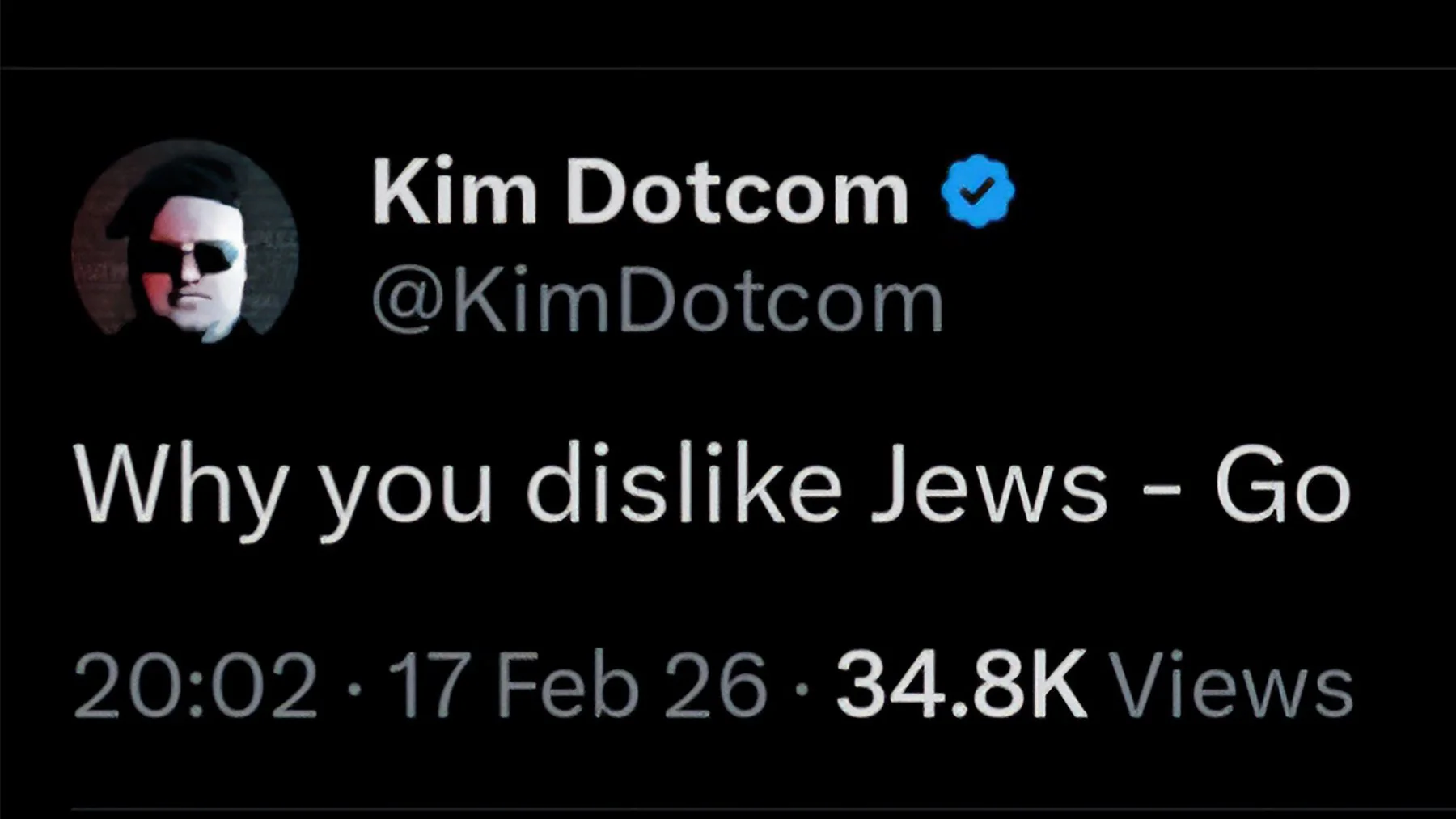
Recently, Kim Dotcom — founder of Megaupload and one of New Zealand’s most recognisable controversial public figures — posted the following prompt on X:
“Why you dislike Jews – Go.”
There was no political framing. No mention of Israel. No reference to Zionism.
Simply: “Why you dislike Jews.”
The statement was not subtle. It was not coded. It was not plausibly ambiguous. It was an open invitation to articulate hostility toward Jews as Jews.
And yet, in New Zealand’s mainstream media environment, the reaction was… silence.
Outlets such as The New Zealand Herald and Stuff routinely monitor Dotcom’s social media output. His legal saga, political commentary, and even personal updates frequently generate coverage. Journalists, including commentators such as Philip Matthews, openly engage with his posts.
But when a high-profile public figure invites his audience to enumerate reasons for disliking Jews, the matter appears to fall beneath the threshold of newsworthiness.
That asymmetry deserves examination.
1. From “Edgy” to Explicit
In contemporary discourse, antisemitism often hides behind euphemism: “globalists,” “Zionist control,” “dual loyalty,” or insinuations about finance and media. The ambiguity allows defenders to claim political intent rather than ethnic hostility.
Dotcom’s formulation dispensed with euphemism. It did not reference Israel or geopolitics. It addressed Jews as a people.
When explicit hostility is treated as mere trolling, something significant has shifted. The boundary between fringe hate and public discourse erodes not with dramatic ruptures, but with quiet indifference.
2. The “He’s Just Provoking” Defence
One explanation for the silence may be fatigue. Dotcom has long cultivated notoriety. Editors may reasonably conclude that amplifying inflammatory posts serves his brand.
But the decision to ignore speech is not neutral. When antisemitism is categorised as “just another provocation,” it is implicitly downgraded from racism to performance.
Intent does not nullify impact. A rhetorical invitation to justify disliking Jews normalises the idea that such dislike is a legitimate subject for open debate.
3. The Hierarchy of Harms
It is difficult to imagine a comparable prompt — “Why you dislike Māori – Go” or “Why you dislike Muslims – Go” — passing without immediate condemnation.
New Zealand’s public culture rightly treats racial hostility toward Māori and Muslim communities as morally intolerable. Political leaders would likely respond. Media would report. Civil society groups would speak.
The relative quiet in this case suggests an uncomfortable possibility – antisemitism occupies a lower rung in New Zealand’s hierarchy of harms.
Several dynamics contribute to this:
The Jewish community is small and often perceived as socially secure.
Antisemitism is seen as imported rather than domestic.
Jews are frequently mischaracterised as “privileged,” diluting perceptions of vulnerability.
Post-October 7 polarisation has blurred lines between anti-Israel rhetoric and hostility toward Jews.
When prejudice is perceived as low-risk, it attracts less scrutiny.
4. Free Speech vs Moral Speech
New Zealand’s debate over hate-speech reform has produced understandable caution among journalists wary of appearing censorious. But condemning racism is not equivalent to advocating legal sanction.
The issue here is not whether Dotcom should be prosecuted. It is whether overt antisemitism should be treated as socially unacceptable.
Free speech protects the right to speak. It does not require society to respond with indifference.
5. Normalisation Through Non-Reaction
The most concerning effect of silence is not reputational harm to one individual. It is cultural conditioning.
When overt antisemitism generates no institutional response, three messages are conveyed:
Jews are a permissible target of open hostility.
Antisemitism is not taken as seriously as other forms of racism.
The Jewish community’s concerns can be deprioritised without consequence.
Normalisation rarely announces itself. It advances through lowered expectations.
6. A Post-October 7 Context
Since October 7, global antisemitic incidents have risen sharply. In many societies, hostility toward Israel has metastasised into hostility toward Jews. New Zealand has not been immune.
In this environment, rhetorical prompts inviting collective dislike of Jews do not occur in a vacuum. They feed into an ecosystem where Jewish identity is increasingly framed as politically suspect.
Silence in such moments does not maintain neutrality. It shapes the boundaries of what is considered tolerable.
7. The Responsibility of Prominence
Dotcom is not an anonymous user. He remains a widely recognised public figure because of his role in Megaupload and the long-running extradition saga involving the FBI. His prominence is precisely why journalists monitor his output.
Prominence magnifies impact. When inflammatory speech comes from a recognised figure, the threshold for scrutiny should rise — not fall.
Conclusion: What Silence Reveals
The core issue is not one man’s social-media conduct. It is the social response.
If antisemitism is treated as noise — as background provocation unworthy of attention — it signals a moral inconsistency in how racism is ranked and recognised.
New Zealand rightly prides itself on social cohesion and pluralism. Those commitments are tested not only by overt crisis, but by moments when hatred appears casually, stripped of disguise.
The question is not whether controversial figures should be amplified.
The question is whether explicit hostility toward Jews is still considered unacceptable in principle — or merely impolite in tone.
The answer lies less in the post itself than in the silence that followed.